
Was denken Sie, seit wann H5N1 als “Gefahr”, aufgrund einer potentiellen Pandemie, für Menschen weltweit aufgebaut wird?
Nun, aufgetaucht ist das Virus 1997 in Hong Kong.
 Der übliche Massenmord an Vögeln soll der vermeintlichen Gefahr für Menschen ein Ende bereitet haben. Indes, das Potential von H5N1, als Methode, Menschen Angst zu machen, wurde schnell erkannt, denn im Mai 1997 erkrankten 18 Personen in Hong Kong an H5N1 und 6 davon sind verstorben. Daraus, aus 18 Infektionen und sechs Toten hat nicht zuletzt die EU geschlossen, dass “an influenza pandemic could be imminent“, weshalb Regierungen der Mitgliedsstaaten der EU mit vorbeugenden Maßnahmen reagiert haben. Indes, den vorbeugenden Maßnahmen ging ein Treffen, einer so gennanten ad-hoc-Gruppe zu übertragbaren Krankheiten am 14. Januar 1998 voraus, initiiert vom DGV, der Direction General 5 der Europäischen Kommission.
Schon Anfang 1998 wurde die Sorge, vielleicht auch Hoffnung, immerhin lässt sich mit H5N1 viel Geld verdienen, die Sorge dass H5N1 zur Pandemie werden könnte, ausgiebig ausgebreitet und die Teilnehmer der ad-hoc-Gruppe haben zu ihrem Schrecken festgestellt, dass es keine Impfstoffe gegen das gerade erst gefundene Virus H5N1 gibt. Wie gewöhnlich, so hat auch diese Feststellung dazu geführt, dass Millionen Euro aus Steuergeldern in die Erforschung eines Impfstoffes gegen H5N1 geflossen sind.
Ein lukratives Geschäft.
Bester Beleg dafür ist die Anzahl der Impfstoffe gegen H5N1, an denen derzeit geforscht wird.
Am besten Sie scrollen drüber:
| NCT Number | Study Title | Sponsor |
| NCT03038776 | Recombinant H7 Hemagglutinin Influenza Vaccine Trial | Vaxine Pty Ltd |
| NCT00530660 | Safety and Immunogenicity Study of a Booster Vaccination With a Non-Adjuvanted H5N1 Influenza Vaccine (Follow Up to Study 810501) | Ology Bioservices |
| NCT02743676 | A Retrospective, Observational Registry of Participants With Avian Influenza Infection | Hoffmann-La Roche |
| NCT04669691 | A Dose-ranging Pediatric Study of an Adjuvanted Pandemic Influenza Vaccine | Seqirus |
| NCT03651544 | The Study of the Safety, Reactogenicity and Immunogenicity of the GamFluVac | Gamaleya Research Institute of Epidemiology and Microbiology, Health Ministry of the Russian Federation |
| NCT01142362 | Study of VGX-3400X, H5N1 Avian Influenza Virus DNA Plasmid + Electroporation in Healthy Adults | Inovio Pharmaceuticals |
| NCT01107262 | Avian Influenza Studies In Lebanon | St. Jude Children’s Research Hospital |
| NCT00311480 | Safety and Immunogenicity of Two Doses, Administered Three Weeks Apart, of Two(Surface Antigen Adjuvanted With MF59C.1) Influenza Vaccines in Non-Elderly Adult and Elderly Subjects | Novartis |
| NCT01258062 | Study to Assess Safety of an Inactivated H5N1 Influenza Vaccine Administered in GelVac Nasal Powder to Healthy Young Adults | Ology Bioservices |
| NCT00417560 | Inactivated Influenza A/H5N1 Vaccine in Adult Subjects at Risk of Occupational Exposure to Live H5N1 Viruses | Centers for Disease Control and Prevention |
| NCT03834376 | Pre-Approval Access to Pimodivir for the Treatment of Patients With H7N9 Influenza A Infection | Janssen Research & Development, LLC |
| NCT03472976 | H5N1 With or Without Topical Aldara in Healthy Adults | National Institute of Allergy and Infectious Diseases (NIAID) |
| NCT01184976 | Study Of VGX-3400, H5N1 Avian Flu Virus Plasmid DNA With Electroporation Device In Healthy Adult Males | GeneOne Life Science, Inc. |
| NCT00900991 | Safety and Immunogenicity of a Split-Virion Pandemic Influenza A (H5N1) Vaccine in Children | Sinovac Biotech Co., Ltd |
| NCT01698060 | Immunogenicity of ND1.1 by Delivery Directly to the Ileum | Vaxart |
| NCT03755427 | A Study of An Adjuvanted Inactivated H7N9 Influenza Vaccine | Shanghai Institute Of Biological Products |
| NCT00489931 | Phase I Open-Label Study of Recombinant DNA Plasmid Vaccine, VRC-AVIDNA036-00-VP, Encoding for Influenza Virus H5 Hemagglutinin Protein Given Intradermally | National Institute of Allergy and Infectious Diseases (NIAID) |
| NCT00884182 | Safety and Immunogenicity of an Intramuscular A/H5N1 Inactivated, Split Virion Pandemic Influenza Vaccine in Children | Sanofi Pasteur, a Sanofi Company |
| NCT00841763 | Safety, Tolerability and Immunogenicity of Two Doses of Adjuvanted Monovalent Influenza Vaccine Administered to Healthy Adult and Elderly Subjects | Novartis |
| NCT02078674 | A(H7N9) VLP Antigen Dose-Ranging Study With Matrix-M1™ Adjuvant | Novavax |
| NCT00783926 | Phase 1 Study of a H5N1 Influenza Vaccine (Reverse Genetic Reassortant) | Ology Bioservices |
| NCT00640874 | A Prospective Study to Examine the Effectiveness and Safety of Antivirals in Volunteers Who Receive Short-term Prophylaxis Against Pandemic Influenza | Kirby Institute |
| NCT03682120 | Safety/Efficacy Study of Seqirus A/H7N9 IIV With or Without MF59® Adjuvant to Prevent Avian Influenza | National Institute of Allergy and Infectious Diseases (NIAID) |
| NCT01594320 | A/H5N1 Virus-Like Particle Antigen Dose Ranging Study With Adjuvant 1 | Novavax |
| NCT03745274 | Two Doses of GHB04L1 for Pandemic Influenza Prophylaxis in Healthy Adults | AVIR Green Hills Biotechnology AG |
| NCT00439530 | Pharmacologic Study of Oseltamivir in Healthy Volunteers | Mahidol University |
| NCT02839330 | A Study to Evaluate Safety, Immunogenicity, and Lot-to-Lot Consistency of H5N1 Subunit Influenza Virus Vaccine in Healthy Adult Subjects ≥18 Years of Age | Seqirus |
| NCT00337896 | T and B Cell Response to Avian Flu Vaccine | National Institute of Allergy and Infectious Diseases (NIAID) |
| NCT00439335 | Higher Dose Intradermal H5 Vaccine | National Institute of Allergy and Infectious Diseases (NIAID) |
| NCT00516035 | Single Group Study of the Safety of and Immune Response to a Bird Flu Vaccine (H7N3) in Healthy Adults | National Institute of Allergy and Infectious Diseases (NIAID) |
| NCT00478816 | Safety and Immunogenicity of Two Doses of H5N1 Influenza Vaccine in Adults Unprimed and Primed With Adjuvanted or Non-adjuvanted Influenza Vaccines | Novartis Vaccines |
| NCT00537524 | Immunogenicity, Safety and Tolerability of Two Doses of a Pre-pandemic Influenza Vaccine in Participants Aged 6 Months to 17 Years | Novartis Vaccines |
| NCT01044095 | Study of Seasonal Influenza Vaccine Against H5N1 Avian Influenza Virus | Armed Forces Research Institute of Medical Sciences, Thailand |
| NCT01995695 | Safety and Immunogenicity of a Live Attenuated H7N9 Influenza Virus Vaccine in Healthy Adults | National Institute of Allergy and Infectious Diseases (NIAID) |
| NCT00347672 | Safety of and Immune Response to a Bird Flu Virus Vaccine (H5N1) in Healthy Adults | National Institute of Allergy and Infectious Diseases (NIAID) |
| NCT00545701 | Immunogenicity and Safety of an Intramuscular A/H5N1 Inactivated, Split Virion Pandemic Influenza Vaccine in Adults | Sanofi Pasteur, a Sanofi Company |
| NCT01897701 | A(H7N9) VLP Antigen Dose Ranging Study With Adjuvant 1 | Novavax |
| NCT00519389 | Safety, Reactogenicity and Immunogenicity of an H5N1 VLP | Novavax |
| NCT02586792 | H7N9 Boost in Healthy Adults | National Institute of Allergy and Infectious Diseases (NIAID) |
| NCT02095444 | Using Human Menstrual Blood Cells to Treat Acute Lung Injury Caused by H7N9 Bird Flu Virus Infection | S‑Evans Biosciences Co., Ltd. |
| NCT01323946 | Study to Evaluate the Immunogenicity and Safety of an Investigational Pandemic Influenza Vaccine in Children | GlaxoSmithKline |
| NCT00695669 | A Trial to Test the Response to Different Vaccination Regimens With an H5N1 Vaccine With AS03 in Adults Aged 18–64 | GlaxoSmithKline |
| NCT00848029 | Safety and Immunogenicity of Two Doses of Monovalent Inactivated Influenza Vaccine That is Adjuvanted With MF59C.1 (MF59) and Uses a Surface Antigen From a Potential Pandemic Virus Strain Candidate (H5N1) in Adult and Elderly Subjects Using Four Different Vaccination Schedules | Novartis Vaccines |
| NCT00415129 | Safety and Immunogenicity of an Intramuscular Pandemic Influenza Vaccine in Adults and the Elderly | Sanofi Pasteur, a Sanofi Company |
| NCT01382329 | H5N1 Vaccine Study in Japanese Adults | Ology Bioservices |
| NCT00841646 | Safety and Immunogenicity of Two Doses of Monovalent Inactivated Influenza Vaccine That is Adjuvanted With MF59C.1 (MF59) and Uses a Surface Antigen From a Potential Pandemic Virus Strain Candidate (H5N1) in Adult and Elderly Subjects | Novartis Vaccines |
| NCT01573312 | H5N1 Vaccination With and Without AS03: Systems Biology Analysis | National Institute of Allergy and Infectious Diseases (NIAID) |
| NCT00382980 | Dose-Escalating Trial Using Vero Cell-culture Derived H5N1 +/- Aluminum in Adults | National Institute of Allergy and Infectious Diseases (NIAID) |
| NCT00488046 | Single Group Study of the Safety of and Immune Response to a Bird Flu Virus Vaccine (H5N1) in Healthy Adults | National Institute of Allergy and Infectious Diseases (NIAID) |
| NCT00680069 | H5N1 (Clade 2) Vaccination of Adults and Elderly | National Institute of Allergy and Infectious Diseases (NIAID) |
| NCT00240968 | H5 Booster After a Two Dose Schedule | National Institute of Allergy and Infectious Diseases (NIAID) |
| NCT01640691 | Immunogenicity and Safety of Pandemic Influenza Vaccine in Healthy Adults | Adimmune Corporation |
| NCT01236040 | Immunogenicity and Safety of Pandemic Influenza Vaccines in Adults Aged 18 – 49 Years Old | GlaxoSmithKline |
| NCT02719743 | A Dose Ranging Safety and Immunogenicity Study of GlaxoSmithKline (GSK) Biologicals’ GSK1557484A Vaccine in Children 6 to Less Than 36 Months of Age | GlaxoSmithKline |
| NCT00719043 | Immunogenicity & Safety of GSK’s Avian Flu Vaccine 1557484A Given to Adults Aged ≥18 Years | GlaxoSmithKline |
| NCT03739229 | Reactogenicity, Safety and Immunogenicity of a LAIV А/17/Hong Kong/2017/75108 H7N9 Influenza Vaccine | Research Institute of Influenza, Russia |
| NCT01657929 | H5-VLP + GLA-AF Vaccine Trial in Healthy Adult Volunteers | Access to Advanced Health Institute (AAHI) |
| NCT00532792 | A/H5N1 Dose Ranging Study With Adjuvant Patch | Intercell USA, Inc. |
| NCT00895544 | Immunogenicity and Safety Study of a Single Prime-Boost Vaccination Schedule With a H5N1 Influenza Vaccine in Adults | Ology Bioservices |
| NCT01942265 | H7N9 Mix and Match With AS03 and MF59 in Healthy Adults | National Institute of Allergy and Infectious Diseases (NIAID) |
| NCT02480101 | Reactogenicity, Safety and Immunogenicity of a LAIV H7N9 Influenza Vaccine | Research Institute of Influenza, Russia |
| NCT01147068 | Safety and Immunogenicity of PanBlok Influenza Vaccine in Healthy Adults | Protein Sciences Corporation |
| NCT01766921 | Safety and Immunogenicity of Two Doses of H5N1 Influenza Vaccine in Elderly Subjects | Novartis Vaccines |
| NCT02151344 | Evaluating the Safety and Immune Response to a Live H7N9 Influenza Virus Vaccine Followed by an Inactivated H7N9 Influenza Virus Vaccine, Given at Varying Intervals | National Institute of Allergy and Infectious Diseases (NIAID) |
| NCT03312231 | Sanofi 2017 H7N9 With/Without AS03 in Adults/Elderly | National Institute of Allergy and Infectious Diseases (NIAID) |
| NCT00311727 | Cell-Mediated Immune Responses to Influenza A/H5N1 Vaccine | National Institute of Allergy and Infectious Diseases (NIAID) |
| NCT01086657 | An Open-Label, Randomized Phase I Study in Healthy Adults of the Safety and Immunogenicity of Prime-Boost Intervals With Monovalent Influenza Subunit Virion (H5N1) Vaccine, A/Indonesia/05/2005 (Sanofi Pasteur, Inc.) Administered Alone or Following Re… | National Institute of Allergy and Infectious Diseases (NIAID) |
| NCT03581903 | A Study in Healthy Adults to Assess Priming With Antigenically Mismatched Live Attenuated A/H7N3 Influenza Virus Vaccine Followed by Inactivated A/H7N9 Influenza Virus Vaccine | National Institute of Allergy and Infectious Diseases (NIAID) |
| NCT00519064 | Immunogenicity and Safety of an Adjuvanted Inactivated Subunit Influenza Vaccine to Those of a Non-adjuvanted Inactivated Subunit Influenza Vaccine, When Administered to Adults Affected by Chronic Diseases | Novartis Vaccines |
| NCT02206464 | H7 Influenza Prime-Boost Regimens in Healthy Adults: Recombinant H7 DNA Plasmid Vaccine, VRC-FLUDNA071-00-VP, Administered Alone or With Monovalent Influenza Subunit Virion H7N9 Vaccine (MIV) as Prime With MIV Boost Compared to MIV Prime With MIV Boo… | National Institute of Allergy and Infectious Diseases (NIAID) |
| NCT03369808 | A Clinical Trail Of An Adjuvanted Inactivated H7N9 Influenza Vaccine | Shanghai Institute Of Biological Products |
| NCT01195038 | Immunogenicity and Safety Study of a Booster Vaccination With a Recombinant H5N1 Influenza HA Vaccine in Primed Adults | UMN Pharma Inc. |
| NCT00561184 | Safety and Immunogenicity of a Booster Dose of ‑H5N1 Influenza Vaccine | Novartis Vaccines |
| NCT01675284 | A Phase I Study to Evaluate the Safety, Reactogenicity, and Humoral Immune Responses to an Inactivated H5N1 Influenza Vaccine | Medigen Biotechnology Corporation |
| NCT00640302 | A Prospective Study to Examine the Effectiveness and Safety of Neuraminidase Inhibitors in Index Cases With Presumed Pandemic Influenza | Kirby Institute |
| NCT02680002 | Assess the Safety & Immunogenicity of Stored Inactivated Influenza H5N1 Virus Vaccine Given With & Without Stored MF59 Adjuvant | Biomedical Advanced Research and Development Authority |
| NCT01052402 | Safety and Immunogenicity Study of a H5N1 Influenza Vaccine (Vero Cell-Derived, Whole Virus) in Healthy Infants, Children and Adolescents | Ology Bioservices |
| NCT00110279 | Safety of and Immune Response to a Bird Flu Virus Vaccine (H9N2) in Healthy Adults (Study A) | National Institute of Allergy and Infectious Diseases (NIAID) |
| NCT02091908 | Safety and Immunogenicity of Two Doses of aH5N1 Vaccine in Adult and Elderly Subjects With and Without Underlying Medical Conditions | Seqirus |
| NCT00230750 | Inactivated Influenza A/H5N1 Vaccine in the Elderly | National Institute of Allergy and Infectious Diseases (NIAID) |
| NCT00853255 | Group Study of the Safety of and Immune Response to a Single Dose of Bird Flu Vaccine (H7N3) in Healthy Adults | National Institute of Allergy and Infectious Diseases (NIAID) |
| NCT01403155 | A Follow-On Study With an H5 Influenza Vaccine for Subjects Who Participated in Study FLU-001 | Inovio Pharmaceuticals |
| NCT00297050 | Safety and Dose Study of Peramivir for Influenza Treatment | National Institute of Allergy and Infectious Diseases (NIAID) |
| NCT03345043 | Safety, Tolerability, and Immunogenicity of VAL-339851 in Healthy Adult Subjects | ModernaTX, Inc. |
| NCT00755703 | Safety and Immunogenicity Study of Adenovirus-vectored, Intranasal Pandemic Influenza Vaccine. | Altimmune, Inc. |
| NCT01045564 | Safety and Immunogenicity of Vaccine in Adults at Occupational Risk for Influenza A (H5N1) Exposure | GlaxoSmithKline |
| NCT00240903 | Revaccination With Subunit Influenza A/Vietnam/1203/2004 (H5N1) Vaccine | National Institute of Allergy and Infectious Diseases (NIAID) |
| NCT02335164 | A Phase 1 Study to Evaluate the Immunogenicity and Safety of a Pandemic Avian Influenza Vaccine in Adults | Vaxine Pty Ltd |
| NCT03014310 | H5N8 Mix and Match With or Without AS03 or MF59 in Healthy Adults: Immunology | National Institute of Allergy and Infectious Diseases (NIAID) |
| NCT00711295 | Phase 3 Study of a H5N1 Vaccine in Adults, Elderly and Specified Risk Groups | Ology Bioservices |
| NCT01250795 | Safety and Immunogenicity Of A Recombinant H5N1 Vaccine In Adults | Fraunhofer, Center for Molecular Biotechnology |
| NCT01928472 | Dose-finding Study of Four Dosage Levels of an H7N9 Influenza Vaccine in Adults Between Ages of 18 Years and 65 Years | Novartis Vaccines |
| NCT00908687 | A/H5N1/LT Dose Ranging Study | Intercell USA, Inc. |
| NCT00298233 | High-Dose Versus Standard-Dose Oseltamivir to Treat Severe Influenza and Avian Influenza | National Institute of Allergy and Infectious Diseases (NIAID) |
| NCT00434733 | Immunogenicity, Safety and Tolerability of Two Doses of FLUAD-H5N1 Influenza Vaccine in Adult and Elderly Subjects | Novartis |
| NCT00382187 | Safety and Immunogenicity of Two Adjuvanted and One Non-adjuvanted H5N1 Influenza Vaccine in Adults | Novartis Vaccines |
| NCT00280033 | H5 Adult – Chiron Study of Bird Flu Vaccine | National Institute of Allergy and Infectious Diseases (NIAID) |
| NCT00660257 | Safety and Immunogenicity of Booster Dose of An Inactivated,Adjuvanted Whole-Virion Pandemic Influenza(H5N1)Vaccine | Sinovac Biotech Co., Ltd |
| NCT01086566 | Cellular and Humoral Immune Response to Primary and Secondary Immunization With Subvirion H5N1 Vaccines | National Institute of Allergy and Infectious Diseases (NIAID) |
| NCT05422326 | A Study to Evaluate Safety and Immunogenicity of One or Two Booster Vaccinations With H5N6 Influenza Vaccine in Adults Primed With H5N1 Influenza Vaccine or Unprimed | Seqirus |
| NCT00868218 | Study of a Parenterally Administered H5N1 Influenza Vaccine in Healthy Adults | Rebecca Cox |
| NCT01074736 | Host Genetic Susceptibility to Avian Influenza A/H5N1 | South East Asia Infectious Disease Clinical Research Network |
| NCT02295813 | Safety and Pharmacokinetics Study of FBF001 | Fab’entech |
| NCT00694213 | Pandemic Influenza Plasmid DNA Vaccines (Needle-Free) | Vical |
| NCT00311649 | Open Label Evaluation of H5N1 Vaccine at Vaccine Manufacturing Facilities | National Institute of Allergy and Infectious Diseases (NIAID) |
| NCT01999842 | Immunogenicity and Safety Study of GlaxoSmithKline (GSK) Biologicals’ Influenza Vaccine(s) GSK3206641A and GSK3206640A Administered in Adults 18 to 64 Years of Age | GlaxoSmithKline |
| NCT01938742 | H7N9 Mix and Match With MF59 in Healthy Adults | National Institute of Allergy and Infectious Diseases (NIAID) |
| NCT01443936 | Experimental AD4-H5-VTN Vaccine in Healthy Volunteers | National Institute of Allergy and Infectious Diseases (NIAID) |
| NCT00402649 | Open-Label Study of H5 Vaccine in Participants of Protocol 04–077 | National Institute of Allergy and Infectious Diseases (NIAID) |
| NCT02171819 | Influenza A/H5N1 Vaccine Clinical Trial (IVACFLU‑A/H5N1) – Phase 1 | Institute of Vaccines and Medical Biologicals, Vietnam |
| NCT01511419 | Safety Trial of Live Attenuated Influenza (H7N3) Vaccine | PATH |
| NCT00133536 | A/H5N1 Vaccine in Healthy Children Aged 2–9 Years | National Institute of Allergy and Infectious Diseases (NIAID) |
| NCT00310206 | H5N1 Vaccine Intramuscular Versus Intradermal in Healthy Adults | National Institute of Allergy and Infectious Diseases (NIAID) |
| NCT00294099 | H5 Vaccine Alone or With Aluminum Hydroxide in Elderly Adults | National Institute of Allergy and Infectious Diseases (NIAID) |
| NCT00517517 | Safety and Immunogenicity Study of Two Doses of an Inactivated H5N1 Influenza Vaccine (Whole Virion, Vero Cell Derived) | Ology Bioservices |
| NCT00296634 | H5 Vaccine Alone or With Adjuvant in Healthy Adults | National Institute of Allergy and Infectious Diseases (NIAID) |
| NCT02177734 | Immunogenicity and Safety Study of GlaxoSmithKline (GSK) Biologicals’ Influenza Vaccine(s) GSK3277510A and GSK3277509A in Adults 18 to 60 Years of Age | GlaxoSmithKline |
| NCT01353534 | Open-label Study to Assess Immunogenicity and Safety of a Vaccine Enhancement Patch When Administered With 2 Doses of H5N1 Vaccine | Intercell USA, Inc. |
| NCT01317758 | H5N1 Mix and Match With AS03 | National Institute of Allergy and Infectious Diseases (NIAID) |
| NCT00912496 | Booster Trial to 07–0019 With A/Anhui/05 With and Without MF59 | National Institute of Allergy and Infectious Diseases (NIAID) |
| NCT01596725 | A/H5N1 Virus-Like Particle Antigen Dose Ranging Study With Adjuvant 2 | Novavax |
| NCT02691130 | Assess the Safety and Immunogenicity of M‑001 as A Standalone Influenza Vaccine and as A H5N1 Vaccine Primer in Adults | BiondVax Pharmaceuticals ltd. |
| NCT02229357 | Evaluation of Priming Effects by PLAI Vaccine on the Subsequent Response to Inactivated H5N1 Vaccine | Mahidol University |
| NCT01776541 | Safety and Immunogenicity of Two Doses of H5N1 Influenza Vaccine in Healthy Adults | Novartis Vaccines |
| NCT01037634 | Safety and Efficacy of Oseltamivir in Children Younger Than One Year of Age | National Institute of Allergy and Infectious Diseases (NIAID) |
| NCT01578317 | Immune Responses to H5N1 Vaccine With and Without AS03 Adjuvant | National Institute of Allergy and Infectious Diseases (NIAID) |
| NCT00115986 | A/H5N1in Adult – Aventis | National Institute of Allergy and Infectious Diseases (NIAID) |
| NCT01443663 | Evaluating the Safety and Immune Response to an H5N1 Influenza Vaccine in People Who Have Previously Received an H5N1 or H7N3 Influenza Vaccine and in People Who Have Never Received a Live Attenuated Influenza Vaccine | National Institute of Allergy and Infectious Diseases (NIAID) |
| NCT00664417 | Study of Different Formulations of an Intramuscular A/H5N1 Inactivated, Split Virion Influenza Adjuvanted Vaccine | Sanofi |
| NCT03738241 | 2017 A/H7N9 IIV Revaccination | National Institute of Allergy and Infectious Diseases (NIAID) |
| NCT02624219 | H5N8 Mix and Match With or Without AS03 or MF59 in Healthy Adults | National Institute of Allergy and Infectious Diseases (NIAID) |
| NCT03283319 | Panblok H7 Vaccine Adjuvanted With AS03 or MF59 | Biomedical Advanced Research and Development Authority |
| NCT00349141 | Safety and Immunogenicity Study of an Inactivated H5N1 Influenza Vaccine (Whole Virion, Vero Cell Derived) | Ology Bioservices |
| NCT01310413 | Monovalent H5N1 Vaccine GSK1557484A in Children 6 Months to < 18 Years of Age | GlaxoSmithKline |
| NCT00812019 | Dose Ranging Study to Evaluate Immunogenicity and Safety of Adjuvanted or Non-adjuvanted Cell Culture-derived H5N1 Influenza Vaccine in Young Adults (18–40 Years Old) | Seqirus |
| NCT05397119 | A Safety and Immunogenicity of Intranasal Nanoemulsion Adjuvanted Recombinant Pandemic Flu Vaccine in Healthy Adults | BlueWillow Biologics |
| NCT01298206 | Case-control Study of Pandemic A/H1N1 Influenza Risk Factors In Lebanon | St. Jude Children’s Research Hospital |
| NCT01389466 | Study to Evaluate the Safety and Immunogenicity of MG1109 in Healthy Adult Volunteers | Green Cross Corporation |
| NCT00481065 | Immunogenicity, Safety and Tolerability of Prepandemic Influenza and Seasonal Influenza Vaccine in Adult Subjects | Novartis |
| NCT01379937 | A Study to Evaluate the Safety and Immunogenicity of a Prime-boost Schedule of GSK Biologicals’ Influenza Vaccine in Children | GlaxoSmithKline |
| NCT01910519 | Systems Biology of Influenza A (H5N1) Virus Monovalent Vaccine With and Without Adjuvant System 03 (AS03) | National Institute of Allergy and Infectious Diseases (NIAID) |
| NCT00814385 | Immunogenicity of Adjuvanted or Non-adjuvanted H5N1 Booster Vaccine in Adults Primed to A/VN/1194/04 | University Hospitals, Leicester |
| NCT00491985 | Safety and Immunogenicity of 2 Formulations of an Intramuscular A/H5N1 Pandemic Influenza Vaccine in Children | Sanofi Pasteur, a Sanofi Company |
| NCT00408109 | Safety Study of Avian Flu Vaccine | National Institute of Allergy and Infectious Diseases (NIAID) |
| NCT00771615 | Immunogenicity & Safety of GSK’s Avian Flu Vaccine 1557484A Given to Adults Aged 18–64 Years | GlaxoSmithKline |
| NCT01656356 | Phase I Safety and Immunogenicity of Live Attenuated Influenza H5 Candidate Vaccine Strain A/17/Turkey/Turkey/05/133 (H5N2) in Healthy Thai Volunteers | Mahidol University |
| NCT02612909 | A Safety and Immunogenicity Study of IVACFLU‑A/H5N1 | Institute of Vaccines and Medical Biologicals, Vietnam |
| NCT02107807 | Safety and Immunogenicity of Two Doses of aH5N1 Vaccine in Adult and Elderly Subjects With and Without Immunosuppressive Conditions *aH5N1:Monovalent H5N1 Influenza Vaccine | Seqirus |
| NCT00457509 | Safety and Immunogenicity of H5N1 Adjuvanted, Inactivated, Split-Virion Pandemic Influenza Vaccine in Healthy Adults | Sanofi Pasteur, a Sanofi Company |
| NCT00428753 | China Case Control Avian Influenza | National Institute of Allergy and Infectious Diseases (NIAID) |
| NCT00703053 | H5N1 Priming and Boosting Strategies | National Institute of Allergy and Infectious Diseases (NIAID) |
| NCT01317745 | H5N1 Mix and Match With MF59 | National Institute of Allergy and Infectious Diseases (NIAID) |
| NCT01676675 | A Phase I Clinical Trial With Whole Virus Inactivated Influenza H5N1 Vaccine in Healthy Adolescents and Adults | Jiangsu Province Centers for Disease Control and Prevention |
| NCT00397215 | Evaluate Safety & Immunogenicity of a Pandemic Influenza Vaccine (GSK1562902A) in Adults Over 60 Years of Age | GlaxoSmithKline |
| NCT00620815 | Safety and Immunogenicity of Two Doses of a Tetravalent Influenza Vaccine in Adults Aged 18 Years and Above | Novartis Vaccines |
| NCT00462215 | Phase 3 Immunogenicity and Safety Study of an Inactivated H5N1 Influenza Vaccine (Whole Virion, Vero Cell Derived) | Ology Bioservices |
| NCT01774032 | H5N1 Vaccine Study in Japanese Elderly Population Aged 65 Years and Older | Ology Bioservices |
| NCT01150552 | Studies of Avian Influenza Transmission to Humans in Egypt | St. Jude Children’s Research Hospital |
| NCT00709800 | Pandemic Influenza Plasmid DNA Vaccines (Needle) | Vical |
| NCT01658800 | Study of the Safety and Immunogenicity of a Novel H5N1 Influenza Vaccine in Healthy Adults Age 18–49 | VaxInnate Corporation |
| NCT00734175 | Safety of and Immune Response to Recombinant Live-Attenuated Influenza H6N1 Virus Vaccine Vaccine | National Institute of Allergy and Infectious Diseases (NIAID) |
| NCT00311675 | St. Jude Open Label H5 Trial | National Institute of Allergy and Infectious Diseases (NIAID) |
| NCT00922259 | Safety and Immunogenicity of Live Influenza A Vaccine for Avian Influenza H7N7 | National Institute of Allergy and Infectious Diseases (NIAID) |
| NCT03318315 | Co-Administration of AS03 Adjuvanted A/H7N9 IIV With IIV4 | National Institute of Allergy and Infectious Diseases (NIAID) |
| NCT00380237 | Safety of and Immune Response to a Bird Flu Virus Vaccine (H9N2) in Healthy Adults (Study B) | National Institute of Allergy and Infectious Diseases (NIAID) |
| NCT03330899 | Safety and Immunogencity of H7N9 Influenza Antigen With 2 Adjuvant Formulations in Healthy Adults in Brazil | Butantan Institute |
| NCT03497845 | Assess the Safety & Immunogenicity of Prime-Boost Vaccination Strategies Using H5Nx Virus Vaccine Adjuvanted With AS03 or MF59 | Biomedical Advanced Research and Development Authority |
| NCT02274545 | Evaluating the Safety and Immunogenicity of a H7N9 Vaccine for the Prevention of Influenza H7N9 Disease in Adults 50 to 70 Years Old | National Institute of Allergy and Infectious Diseases (NIAID) |
| NCT01335347 | Safety Study of an Oral Vaccine to Prevent Avian Influenza | Vaxart |
| NCT00309647 | Study to Evaluate the Safety and Immunogenicity of Pandemic Monovalent (H5N1) Influenza Vaccines (Whole Virus Formulation) in Adults 18 and 60 Years of Age | GlaxoSmithKline |
| NCT00980447 | Immunogenicity, Safety and Optimal Dose Finding Study of Recombinant Influenza H5N1 Vaccine in Healthy Young Adults | UMN Pharma Inc. |
| NCT00984945 | Safety Study of a Plant-based H5 Virus-Like Particles (VLP) Vaccine in Healthy Adults | Medicago |
| NCT00356798 | Randomized, Double Blinded, Placebo Control Clinical Trial of Pandemic Influenza Inactive Vaccine on Healthy Subjects | Sinovac Biotech Co., Ltd |
| NCT01006798 | Safety and Immunogenicity of Replication-Competent Adenovirus 4‑vectored Vaccine for Avian Influenza H5N1 | Emergent BioSolutions |
| NCT00319098 | Study to Evaluate the Safety and Immunogenicity of a Pandemic Influenza Vaccine in Adults Aged 18 Years and Above | GlaxoSmithKline |
| NCT01416571 | Immunogenicity and Safety Study of GlaxoSmithKline (GSK) Biologicals’ Monovalent Pandemic H5N1 Vaccine in Adults | GlaxoSmithKline |
| NCT00428493 | Prospective Study of AI H5N1 in China | National Institute of Allergy and Infectious Diseases (NIAID) |
| NCT02957656 | Safety and Immunogenicity of Priming With Live Attenuated A/H7N9 Influenza Virus Vaccine Followed By Inactivated A/H7N9 Influenza Virus Vaccine With AS03 Adjuvant | National Institute of Allergy and Infectious Diseases (NIAID) |
| NCT02153671 | Immunogenicity of H5N1 Vaccine Following H5N2 | PATH |
| NCT00914771 | Safety and Immunogenicity of Two Doses, Administered Three Weeks Apart, of Two Monovalent H5N1 Influenza Vaccines Containing 2 Doses of H5N1 Influenza Antigen, in Non-elderly Adult and Elderly Subjects | Novartis Vaccines |
| NCT00383071 | Development of Immune Globulin Treatment for Avian Flu | National Institute of Allergy and Infectious Diseases (NIAID) |
| NCT01560793 | Safety and Immunogenicity of a Novel H5N1 Influenza Vaccine in Healthy Adults Age 18–49 Years | VaxInnate Corporation |
| NCT01776554 | Safety and Immunogenicity of Two Doses of H5N1 Influenza Vaccine in Children | Novartis Vaccines |
| NCT04789577 | A Study to Evaluate the Safety and Immunogenicity of GlaxoSmithKline Biologicals’ Influenza Vaccine GSK3206641A Administered in Adults 18 to 64 Years of Age and 65 Years of Age and Older | GlaxoSmithKline |
| NCT02213354 | H7N9 Mix and Match With MF59 in Healthy Elderly Persons | National Institute of Allergy and Infectious Diseases (NIAID) |
| NCT03701061 | Durability and Impact of the Seasonal Influenza Vaccine on H5 Induced B Cell Response | Emory University |
| NCT02436928 | A Study to Evaluate the Safety and Immunogenicity of H7N9 Influenza Vaccine (AT-501) in Healthy Adult Subjects | Medigen Vaccine Biologics Corp. |
| NCT03196661 | Preliminary Study on Safety and Immunogenicity of Influenza A (H7N9) Vaccine in the Population | Hualan Biological Bacterin Co. Ltd. |
| NCT01788228 | Safety and Tolerability Study of GlaxoSmithKline (GSK)1557484A Vaccine in Adults at Occupational Risk for Influenza A (H5N1) Exposure | GlaxoSmithKline |
| NCT00640211 | A Prospective Study to Examine the Effectiveness and Safety of Neuraminidase Inhibitors in Volunteers Who Receive Long-term Prophylaxis Against Pandemic Influenza: PIPET B | Kirby Institute |
| NCT03816878 | Immunogenicity and Safety Study of Inactivated Subunit H5N1 Influenza Vaccine in Prior Recipients of Live Attenuated H2N2, H6N1 and H9N2 Influenza Vaccines and in H5N1 and Live Attenuated Vaccine Naïve Individuals | National Institute of Allergy and Infectious Diseases (NIAID) |
| NCT00776711 | Vaccine for Prevention of Bird Flu | National Institute of Allergy and Infectious Diseases (NIAID) |
| NCT03589807 | 2013/2017 H7N9 Prime-Boost Interval | National Institute of Allergy and Infectious Diseases (NIAID) |
| NCT02251288 | A Phase I Study Priming With an Inactivated A/H7N9 Influenza Virus Vaccine With or Without MF59 Adjuvant Followed by Live Attenuated A/H7N9 Influenza Virus Vaccine | National Institute of Allergy and Infectious Diseases (NIAID) |
| NCT00900588 | Safety and Immunogenicity of a Split-Virion Pandemic Influenza A (H5N1) Vaccine in Adolescents | Sinovac Biotech Co., Ltd |
| NCT01987011 | Phase III Study to Evaluate the Immunogenicity and Safety of MG1109 in Healthy Adult Volunteers | Green Cross Corporation |
| NCT02921997 | H7N9 Vaccination With and Without AS03 and Unadjuvanted H3N2v Vaccination: Standard and Systems Biology Analyses | National Institute of Allergy and Infectious Diseases (NIAID) |
| NCT01911754 | Japanese Pediatric H5N1 Vaccine Study | Ology Bioservices |
Da ist Geld drin…
Wenn so viele unterschiedliche Pharmafia-Unternehmen an ein und demselben “Impfstoff” basteln, gegen ein Virus das sich nach wie vor standhaft weigert, von Mensch zu Mensch übertragbar in relevantem Ausmaß zu sein, dann muss man kein Prophet sein, um zu wissen, dass die hier versammelten finanziellen Interessen einen Weg finden werden, ihre Forschung zu Milliarden zu machen.
Indes, wie gesagt, es gibt da ein Problem.
Seit 1998 wird die Gefahr von H5N1/Vogelgrippe als Material, aus dem tödliche Pandemien sind, stetig beschworen, indes, H5N1 weigert sich standhaft.
Hier ein paar Beispiele der akademischen Panikmachen:
2004:
Guan, Y., L. L. M. Poon, C. Y. Cheung, T. M. Ellis, W. Lim, A. S. Lipatov, K. H. Chan et al. (2004). H5N1 influenza: a protean pandemic threat. Proceedings of the National Academy of Sciences 101(21): 8156–8161.Ergebnis: H5N1 wird ansteckender und zu einer zunehmenden Gefahr für Menschen
Anbindung der Autoren: Government Virus Unit, Department of Health, Peoples Republic of China;Ferguson, Neil M., Christophe Fraser, Christl A. Donnelly, Azra C. Ghani, and Roy M. Anderson. (2004). Public health risk from the avian H5N1 influenza epidemic. Science 304(5673): 968–969.
Ergebnis: Die Leute um Neil Ferguson, der Neil Ferguson, der mit falschen Modellen 2020 ein Massensterben an COVID-19 vorhergesagt hat, empfehlen in diesem Beitrag der WHO, die Gefahr, die von H5N1 ausgeht, nicht aufgrund der Fälle tatsächlich infizierter Menschen, sondern aufgrund der verbesserten Fähigkeit des Virus zur Transmission zu beurteilen. Also nicht aufgrund von Fakten, sondern aufgrund der Ergebnisse eines Simulationsmodells. Kommt irgendwie bekannt vor…
Anbidung der Autoren: Imperial College, London;Webster, Robert G., Malik Peiris, Honglin Chen, and Yi Guan (2006). H5N1 outbreaks and enzootic influenza.” Biodiversity 7(1): 51–55.
Ergebnis: “In fact, the root cause of the continuing H5N1 pandemic threat may be the way the pathogenicity of H5N1 viruses is masked by cocirculating influenza viruses or bad agricultural vaccines.”
Dass H5N1 unter Geflügel regelmäßig auftritt, ist nach Ansicht der Autoren u.a. ein Hinweis auf schlechte Impfstoffe, die in der Tierhaltung zum Einsatz kommen. Ein bekanntes Thema …
Anbindung: St Jude Childrens Hospital Fort Lauderdale und University of Hong Kong
2007:
Peiris, JS Malik, Menno D. De Jong, and Yi Guan (2007). Avian influenza virus (H5N1): a threat to human health. Clinical microbiology reviews 20(2): 243–267.
Ergebnis: Natürlich ist H5N1 eine Gefahr für Menschen.
Anbindung der Autoren: University of Hong Kong, Oxford University2011:
Amendola, A., A. Ranghiero, A. Zanetti, and E. Pariani (2011). “Is avian influenza virus A (H5N1) a real threat to human health. Journal of Preventive Medicine and Hygiene 52(3): 107–110.
Ergebnis: Derzeit ist H5N1 keine Gefahr, aber wenn es H5N1 geling, von Mensch zu Mensch übertragbar zu sein, dann schon.
Anbindung der Autoren: University of Milan2012:
To, Kelvin KW, Kenneth HL Ng, Tak-Lun Que, Jacky MC Chan, Kay-Yan Tsang, Alan KL Tsang, Honglin Chen, and Kwok-Yung Yuen (2012). “Avian influenza A H5N1 virus: a continuous threat to humans. Emerging microbes & infections 1(1): 1–12.
Ergebnis: Das Virus entwickelt sich schnell (ist ja auch ein RNA-Virus) und stellt ein kontinuierliches Risiko für eine Pandemie für Menschen dar.
Anbindung der Autoren: Princess Margaret Hospital, Hong Kong, University of Hong Kong2013
Van Kerkhove, Maria D. (2013). Brief literature review for the WHO global influenza research agenda–highly pathogenic avian influenza H5N1 risk in humans. Influenza and other respiratory viruses 7: 26–33.
Ergebnis: Ansteckung nur bei extrem hoher Virenlast für Menschen möglich, keine Indizien für Mensch-zu-Mensch Übertragbarkeit des Virus, aber natürlich ganz große Gefahr…
Anbindung: Imperial College, London
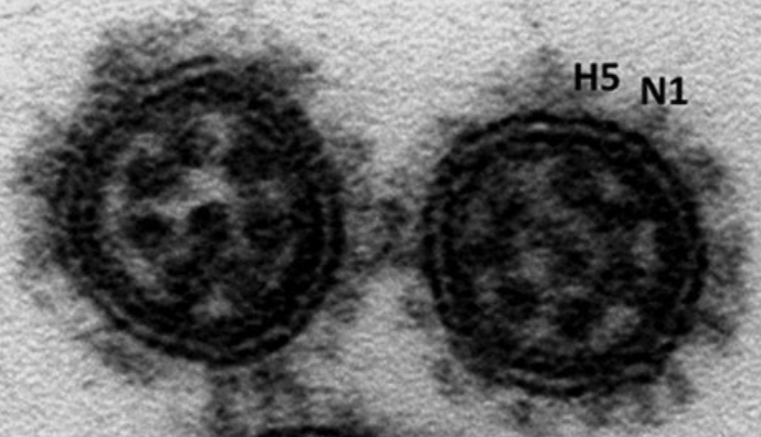

Beenden wir den Überblick an dieser Stelle, schon weil nach 2013 so gut wie keine Beiträge mehr zu finden sind, die sich mit dem Risiko einer Mensch-zu-Mensch-Übertragung von H5N1 befassen. Warum dem so ist, dazu mag die folgende Tabelle einen Erklärungsbeitrag leisten:
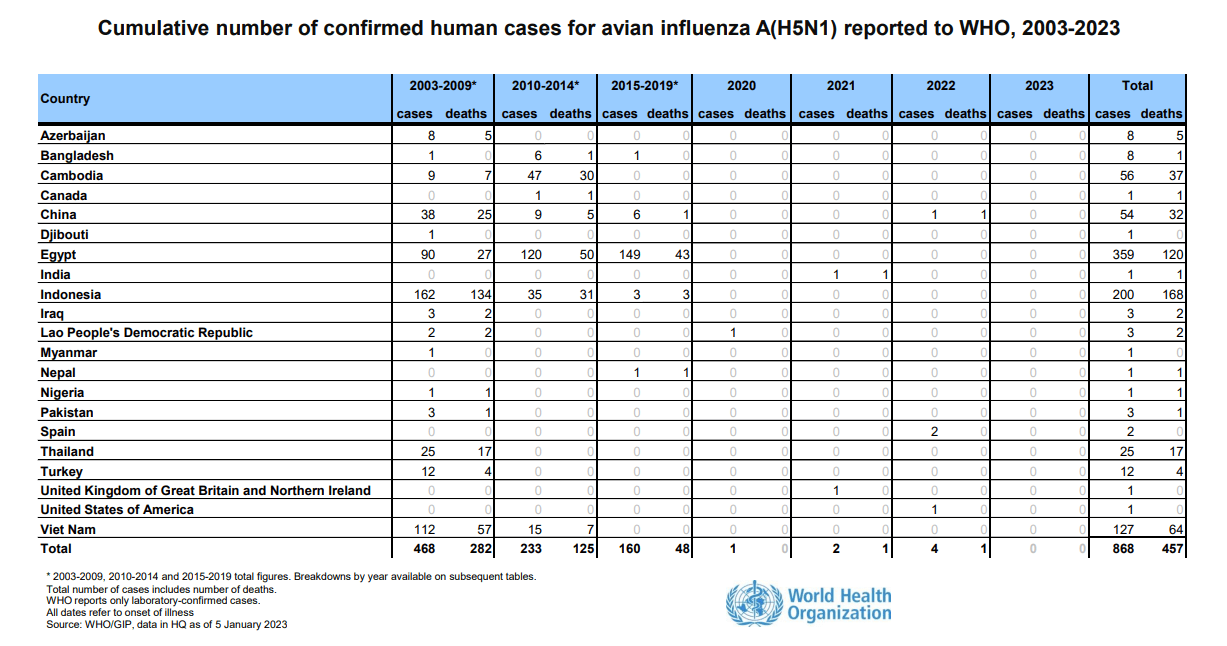
Abgesehen von einem kurzen Ausbruch in Ägypten spielt H5N1 im viralen Geschehen der Welt nach 2014 keine Rolle mehr und die Tatsache, dass Forschung den Verdacht nahegelegt hat, der Masseneinsatz von Impfstoffen gegen H5N1 in der Tierhaltung trage seinen Teil dazu bei, H5N1 virulent und endemisch zu halten, mag auch als Dämpfer für all diejenigen gewirkt haben, die mit ihren Forschungsergebnissen lieber nicht Gefahr laufen, ihre Finanzierung durch die Pharmafia zu verlieren.
Ergo wurde es ruhig um H5N1, so ruhig, dass sich die WHO-Mannen heute redlich mühen müssen, die Angst vor H5N1 künstlich zu schüren und wieder ans Laufen zu bringen:
Sie sehen gerade einen Platzhalterinhalt von Standard. Um auf den eigentlichen Inhalt zuzugreifen, klicken Sie auf den Button unten. Bitte beachten Sie, dass dabei Daten an Drittanbieter weitergegeben werden.
Sie sehen gerade einen Platzhalterinhalt von Standard. Um auf den eigentlichen Inhalt zuzugreifen, klicken Sie auf den Button unten. Bitte beachten Sie, dass dabei Daten an Drittanbieter weitergegeben werden.
Dr Tedros und Jeremy Farrar, gestern noch aktiv an der Vertuschung der Herkunft von SARS-CoV‑2 beteiligt, heute der Chief Medical Adviser bei der WHO, vermutlich zur Belohnung, mühen sich redlich, die in Daten nicht belegbare Gefahr, die von H5N1 ausgeht, zu beschwörden und die Geldmaschine für Pharmafia-Unternehmen am Laufen zu halten. Die Strategie hat sich in all den Jahren, die H5N1 nun schon beschworen wird, nie geändert.
 H5N1 sei derzeit nicht von Mensch-zu-Mensch zu übertragen, so, Farrar, aber dennoch gefährlich, weil die Gefahr bestehe, dass es in Zukunft von Mensch-zu-Mensch übertragbar sein könnte. Eine Aussage, die auf nahezu jedes Virus zutrifft. Indes, H5N1 wurde in den letzten Jahren so prominent aufgebaut und wohl mit Hilfe von “Impfstoffen” virulent unter Tieren gehalten (Webster et al. 2006), dass es derzeit keine Angst-Alternative zu H5N1 gibt. Also müssen die Angst-Agitatoren mit dem arbeiten, was sie haben. Herzlich wenig, wenn man die Tabelle mit den kumulativen Fällen von H5N1 unter Menschen betrachtet.
Deshalb wird derzeit gemolken, was geht, und Farrar gibt sich im letzten Video alle Mühe, das, was er nicht weiß, nicht etwa als Unwissen, sondern als Gefahr auszugeben, was, angesichts der Gefahr, dass uns der Himmel auf den Kopf fallen könnte, auf besonders ängstliche Naturen seine Wirkung nicht verfehlen dürfte. Er hat keine Ahnung, wie die Übertragung von Kühen zu Menschen, Tieren stattfindet, ob sie stattfindet, aber natürlich ist sie eine große Gefahr, was angesichts der Tatsache, dass Farrar keinerlei Daten hat, um die Gefahr zu quantifizieren, seltsam ist. Wenn man nichts weiß, wie kann man dann wissen, dass von dem, von dem man nichts weiß, eine große Gefahr ausgeht?
Wie auch immer.
Das ganze derzeitige Tohuwabohu basiert auf H5N1 unter Rindern und einem Farmarbeiter, der an H5N1 erkrankt ist. Indes, betrachtet man dessen “Krankheitsgeschichte” etwas genauer, dann reibt man sich verwundert die Augen:
Ende März 2024 klagte ein Farmarbeiter über Rötung und Unwohlsein am rechten Auge. Festgestellt wurde eine subkonjunktivale Blutung und eine dünne, seröse Drainage. Ansonsten nichts. Normale Atmung, klare Lunge, kein Fieber, keine respiratorischen Symptome, nichts. Der Farmarbeiter hatte keinerlei Kontakt zu toten oder kranken Vögeln, aber mit gesunden und kranken Milchkühen, die ebenfalls gerötete Augen hatten, weniger Milch gaben, weniger Appetit aufwiesen und zuweilen eine erhöhte Temperatur hatten. Er trage Handschuhe, aber keinen Atem- oder Augenschutz bei der Arbeit mit Kühen. Ein PCR-Test war positiv für H5-Viren, die Symptome des Arbeiters verschwanden nach einer Behandlung mit Oseltamivir. Eine Analyse der Gensequenz des H5N1-Virus, das bei Arbeiter und Kühen festgestellt wurde, zeigte keinerlei Fähigkeit, an menschliche Zellen anzubinden:
“Viral sequences from cattle and from the worker maintained primarily avian genetic characteristics and lacked changes in the hemagglutinin gene that would affect receptor-binding specificity (e.g., binding to α2–6–linked sialic acid receptors, primarily located in the human upper respiratory tract) and transmission risk to humans.”
Uyeki, Timothy M., Scott Milton, Cherissa Abdul Hamid, Cynthia Reinoso Webb, Steven M. Presley, Varun Shetty, Susan N. Rollo et al. (2024). Highly Pathogenic Avian Influenza A (H5N1) Virus Infection in a Dairy Farm Worker. New England Journal of Medicine.
Kurz: Wir sind immer noch da, wo wir 1997 waren, als H5N1 entdeckt wurde.
Keinerlei Hinweis darauf, dass H5N1 die Fähigkeit erlangen könnte, von Mensch-zu-Mensch übertragbar zu sein. Indes, es ist natürlich schon seit Jahren von Mensch zu Mensch übertragbar. Beim ersten Ausbruch von H5N1 in Hong Kong reiste die Mutter einer Infizierten an, um die Kranke zu pflegen. Sie infizierte sich mit H5N1 und verstarb. Indes legen Studien nahe, dass die Virenladung, die benötigt wird, um H5N1 von Mensch zu Mensch zu übertragen, so groß ist, dass man stundenlang dem Virus ausgesetzt sein muss, um überhaupt eine Wahrscheinlichkeit auf Ansteckung und Erkrankung zu haben (van Kerkhove 2014).
Aber selbst dann, wenn man die Daten, die oben in der WHO-Tabelle abgebildet sind, zur Grundlage nimmt, um die Übertragbarkeit von H5N1 statistisch zu quantifizieren, erzielt man Ergebnisse, die die Gefahr, die mit dem Virus verbunden sein soll, etwas relativieren. So finden Yang-Yang et al. (2007) keinerlei statistische Belege dafür, dass ein Ausbruch in der Türkei durch Übertragung von Mensch-zu-Mensch verursacht wurde und die statistischen Belege, die sie für einen Ausbruch in Sumatra gefunden zu haben glauben, sind Junk, denn sie verletzten die Parität mit einem Wertebereich von 0,61 bis 2,14:
“We find statistical evidence of human-to-human transmission (p = 0.009) in Sumatra but not in Turkey (p = 0.114). For Sumatra, the estimated household SAR was 29% (95% confidence interval [CI] 15%–51%). The estimated lower limit on the local R0 was 1.14 (95% CI 0.61–2.14).”
Yang, Yang, M. Elizabeth Halloran, Jonathan D. Sugimoto, and Ira M. Longini Jr. (2007). Detecting human-to-human transmission of avian influenza A (H5N1). Emerging infectious diseases 13(9): 1348.

Es gibt keinerlei Anhaltspunkt dafür, dass von H5N1 derzeit und in absehbarer Zeit eine Gefahr für Menschen ausgeht oder ausgehen wird. Alles, was dazu in den Medien berichtet und von interessierten Kreisen verbreitet wird, dient der Panikmache, der Vorbereitung einer menschengemachten Pandemie, die als zoonotische H5N1-Pandemie ausgegeben werden wird oder dem Zweck, die Legitimation dafür zu schaffen, Milliarden Steuergelder in den Koffern von Pharmafia-Unternehmen zu vergraben.
Der Artikel erschien zuerst bei ScienceFiles.org.






Du muss angemeldet sein, um einen Kommentar zu veröffentlichen.